
By Ava Salti
I’ve been going to baseball games for as long as I can remember. It started with my parents taking my sister and I to New York Yankees games at Yankee Stadium. When my sister and I went to summer camp, there was an annual field trip where we would go to a Hartford Yardgoats (the local Minor League Baseball team) game. When I became a full-hearted New York Mets fan, my friends and I would make the trip to Citi Field to watch every Jacob DeGrom start we could. Then, I ended up in downtown Boston at Emerson College, and “student $9s” at Fenway Park became a staple of my college experience. I’ll never forget taking a Sports Management class and our professor giving us all tickets to go to a Red Sox game instead of class. The team the Red Sox were playing? The New York Mets. Even as the teams and stadiums have changed, baseball has remained a constant presence, reminding me that my passion for the game is as enduring as the sport itself.
Each time I’ve been to a ballpark, I’ve hoped to get my hands on a foul ball. Catching one is a defining element of the live baseball experience. Not even catching one, but just the very possibility of it happening – bringing your old glove to the park, having an idea of what you’ll do if the ball flies to your section – is why so many people make their way to the ballparks for one or more of the 162 games a Major League Baseball (MLB) team plays in a season.
That hope – the dream of catching a ball – has even reshaped the way some teams design the game itself. The Savannah Bananas, a “fan-oriented” exhibition team that routinely sells out football stadiums, have a rule that if a fan catches a foul ball the player who hit it is out.
As exciting as the chase for a ball may be, there’s an overlooked question lingering in the background: who actually owns the baseball? The fan walks out with it (most of the time), but it was owned by MLB just a few hours prior. To be honest, it was not something I completely considered either – that is until I got to law school.
As a 1L student, I knew my classes would rarely, if ever, involve sports. Even as someone who’s all but certain of a path toward sports law, I knew I wouldn’t get much sports in, let’s say — civil procedure. In property, our assignment one week was to read up on the “Rule of Capture.” After reading the famous Pierson v. Post, a case from 1805 involving a dispute over a dead fox, along came Popov v. Hayashi. The first words of Justice McCarthy’s opinion read: “In 1927, Babe Ruth hit sixty home runs. That record stood for thirty-four years until Roger Maris broke it in 1961 with sixty-one home runs. Mark McGwire hit seventy in 1998. On October 7, 2001, at PacBell Park in San Francisco, Barry Bonds hit number seventy-three. That accomplishment set a record which, in all probability, will remain unbroken for years into the future.” At that moment, the world of property law collided with my world of baseball fandom.
I had not been so excited to read a case yet. In fact, I was texting my friends hoping to get cold-called to talk about it. For those unfamiliar, the case revolves around the ball that Bonds hit to break the MLB single-season home run record. The ball ended up in the stands, where it initially ended up in the glove of a fan, Alex Popov, who was instantly tackled by the surrounding fans. All of those fans wanted the ball – some of them wanted it for a piece of history, but most of them wanted it because it would be worth hundreds of thousands of dollars when sold. So, Popov gets tackled, proceeds to lose it to the mob, where it gets picked up by Patrick Hayashi, who was in the vicinity of the mob but wasn’t one of the perpetrators.
Hayashi went home with the ball, much to Popov’s dismay, who sued him for possession of it. The case made it all the way to the United States Supreme Court.
The possessory journey of a MLB baseball is very unique. Every baseball is made in a Rawlings factory in Costa Rica – each one meticulously crafted and tested, including 108 hand-made stitches and X-Rays and CT scans on every ball to ensure their uniform performance in every MLB ballpark. When they’re shipped to each of the 30 teams, each team is mandated to keep them in humidity-controlled chambers. The day of the game, around 100 balls are brought out of the humidor and rubbed with mud from the Delaware River to improve the stickiness and grip of the ball. They’re then arranged for gameplay, with the first dozen handed off to the home plate umpire for the first pitch of the day. Throughout the entire process, the baseballs are property of MLB. When the game starts, the baseballs are still property of the league. When they’re thrown by pitchers, fielded by infielders, and caught by outfielders — you guessed it: still MLB’s property.
Everything changes, though, once the ball is hit into the stands. For the 4-5 seconds it’s in flight, it’s actually unpossessed property, as MLB explicitly and implicitly abandons it. Once it lands in the stands, though, possession goes to the finder. In the case of Barry Bonds’ 73rd home run ball, the Supreme Court couldn’t decide on its one proper “finder.” It was unclear whether Popov would’ve held onto it if he wasn’t tackled by the mob, and in Hayashi’s case, he wasn’t part of the mob — he just picked it up. The Court did something unique: because both men had equal legal claims to it and there’s no way to physically “split” it, the court ordered it to be sold and for the men to split the profit (which went for around $450,000). The case crystalized how a simple foul ball can carry enormous legal weight – not just as a souvenir, but as contested property.
Within the weeks after reading the Popov case, I looked further into the legality surrounding MLB baseballs and their possessory interests. I’ve come across a few different moments in the baseball world, some just within the past few days, that remind me of the constant collision of sports and the law.
Around two weeks ago, Philadelphia Phillies outfielder Harrison Bader hit a home run in a game against the Miami Marlins. The ball bounced into the outfield seats and was picked up off the ground by a father, who gave it to his son. Another woman walked over to the father and son, demanding they give her the home run ball, to which he obliged. The moment went viral online – take a look for yourselves:
Believe it or not, my first thought was: “Popov v. Hayashi!” That woman never possessed the ball, and to get even more technical: she never established a pre-possessery interest in the ball. Just being closer to it does not make her any more legally entitled to possession of it. That father did not have to give it to her, no matter how angry or determined she was. It turns out, though, the father and son got a happy ending and got more than a baseball.
A lot of the times, when a meaningful baseball is caught — usually a milestone home run like a player’s first career home run or a record-setter — team staff will flag down the fan that caught the ball. The staffers will offer the fan a breadth of options: tickets, autographed bats, custom jerseys, clubhouse experiences, and so on. In 2001, after former Mets catcher Mike Piazza hit his 300th career home run, he asked the team to secure the baseball. Around ten Mets staffers demanded the father who caught it and his six-year-old daughter that was holding onto it to give it back. Piazza ended up with the ball, even though the Mets had an explicit policy that fans at Shea Stadium (similar to the policies of the Phillies and Red Sox) can keep MLB baseballs that end up in the seats.
In April of 2024, the fan that caught Shohei Ohtani’s first home run with the Los Angeles Dodgers was also pressured into giving the ball back. At first, the team offered to give her two signed hats for a ball that an auction house representative said “would be worth at least $100,000.” She got them to up their offer – only after team staffers threatened to not authenticate the ball – to the two hats, a signed bat, and a signed ball. Moments like these reveal the battle between a fan’s rightful ownership and a team’s desire to reclaim history.
How strong is a fan’s claim on the ball if teams demand these momentous baseballs back with such strength, flexing their well-equipped muscles to strongarm fans to give balls up? It’s a fair question, and the concept of “relativity of title” helps us understand how strong the fans’ claim on their newly caught foul ball actually is. Because MLB “abandons” the baseball, they no longer have the strongest title when it comes to ownership of it. The person who finds abandoned property becomes the new owner. If you found an abandoned desk on the side of the road and took it into your apartment, that desk is all yours. It doesn’t matter if your neighbor, the mailman, or someone who’s willing to pay for it stops by and asks for it. If you find abandoned property, it’s yours.
Some fans know this very well, and will refuse to give it up — like this one with Alex Rodriguez’ 3,000th career hit — if their price isn’t met. Some fans will try and stronghold the team for more ambitious asks. Most will take the team up on their offers full of autographed merchandise. Myself and many would be inclined to believe a milestone marker, like a player’s first career home run — a lifelong dream and achievement commemorated in a single item — belongs with the player and their family. Catching a ball and coming home with a bag full of signed gear is a trade off that I believe most fans would take. Some fans, though, like this fan that caught Los Angeles Angels outfielder Mike Trout’s 400th career home run, just had one unique request: a catch with his hero:
Yet not every caught ball ends in conflict or coercion. Sometimes, the law and ownership matter less than generosity.
For those who aren’t following MLB this season, Seattle Mariners switch-hitting catcher Cal Raleigh is having a historic — and I mean historic — season. At the time I’m writing, Raleigh is up to 60 home runs, which is the most ever for a catcher and the most ever for a switch-hitter in MLB history. It’s also the third-most home runs in American League history.
Raleigh’s 60th home run ball, an item which in theory, could’ve sold for a substantial amount of money, was caught by a Mariners fan in the right field seats. The fan, who very well knew the value — both historic and monetary — of the ball, handed it to a young boy. The boy and his family were ushered to the clubhouse by Mariners staffers, where they received a bag full of Mariners merch and got to meet Raleigh and others.
The fan that handed the ball off, though, didn’t get ushered away for prized memorabilia. Other fans that witnessed the moment, though, posted about it online, clamoring to get him recognized for such a selfless act. It started to go viral, with many thinking the same thing: “how could someone give away that ball.” Nevertheless, the Mariners tracked him down and him and his family got to meet Raleigh, too.
That baseball was his property — in every sense of the law. Yet, he still elected to give it to someone else. A person’s freedom to do what they want with their property is one of the very fundamentals of property law — and it’s at the core of what makes MLB baseballs so fascinating.
In other sports, namely tennis, football, basketball, and soccer, fans aren’t allowed to keep the ball when it ends up in the stands. The one exception is hockey, but even then, when a player intentionally puts the puck into the stands, they’re assessed a two-minute “Delay of Game” penalty. It’s true that baseball is the only major North American sport where the players try to hit the ball into the stands. It’s not punished — it’s encouraged. The best hitters in the world — including Ohtani, Aaron Judge, Juan Soto, and Bryce Harper — are the best at hitting it into the stands. The best pitchers — Jacob DeGrom, Chris Sale, Framber Valdez, and Paul Skenes — are the best at stopping that exact thing from happening.
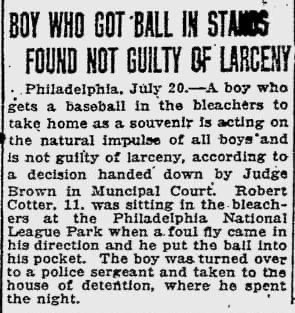
I suppose a MLB organization can implement a policy that gives them the right to retrieve any ball hit into the stands. I don’t believe any MLB team would dare to do that, though, as they would be hit with a massive wave of public backlash. In 1922, 11-year-old Phillies fan Robert Cotter kept a home run ball, and the Phillies’ owners had him arrested by local police. Consequently, all charges were dismissed by the municipal judge. From that point forward, teams allowed their fans to retain the baseballs, which are the key to the entire sport.
Catching a ball at a baseball game is a fascinating experience, one that becomes even more fascinating after understanding its legal implications. As history shows, a single baseball can spark Supreme Court cases, define property rights, or inspire acts of generosity that transcend the law. n the end, each caught ball embodies more than just a moment of play — it captures the intersection of sport, law, and personal choice. Next time you’re at a game and a ball comes your way, know this: it’s not just a souvenir, it’s a story. And what happens to that story is entirely up to you.
 Row 5
Row 5 
Leave a comment